








Free written scope consultation - allowances, timeline, and change-order rules on paper before a single trade is scheduled
Boxabl Kitchen Remodeling: The San Francisco Owner’s Guide
We stock and install kitchen remodeling components sized to work inside Boxabl homes, with full kitchen remodels in San Francisco typically running $16,520 to $53,100 depending on cabinet count, countertop material, and how far you’re willing to take a wall or two. Most owners discover they need this conversation when a cabinet door stops closing square, a countertop seam opens up, or the factory-installed galley layout simply can’t keep up with how the family actually lives. The good news: Boxabl’s compact kitchen footprint means a complete refit is usually a two-to-three week project, not the three-month marathon conventional homes require.
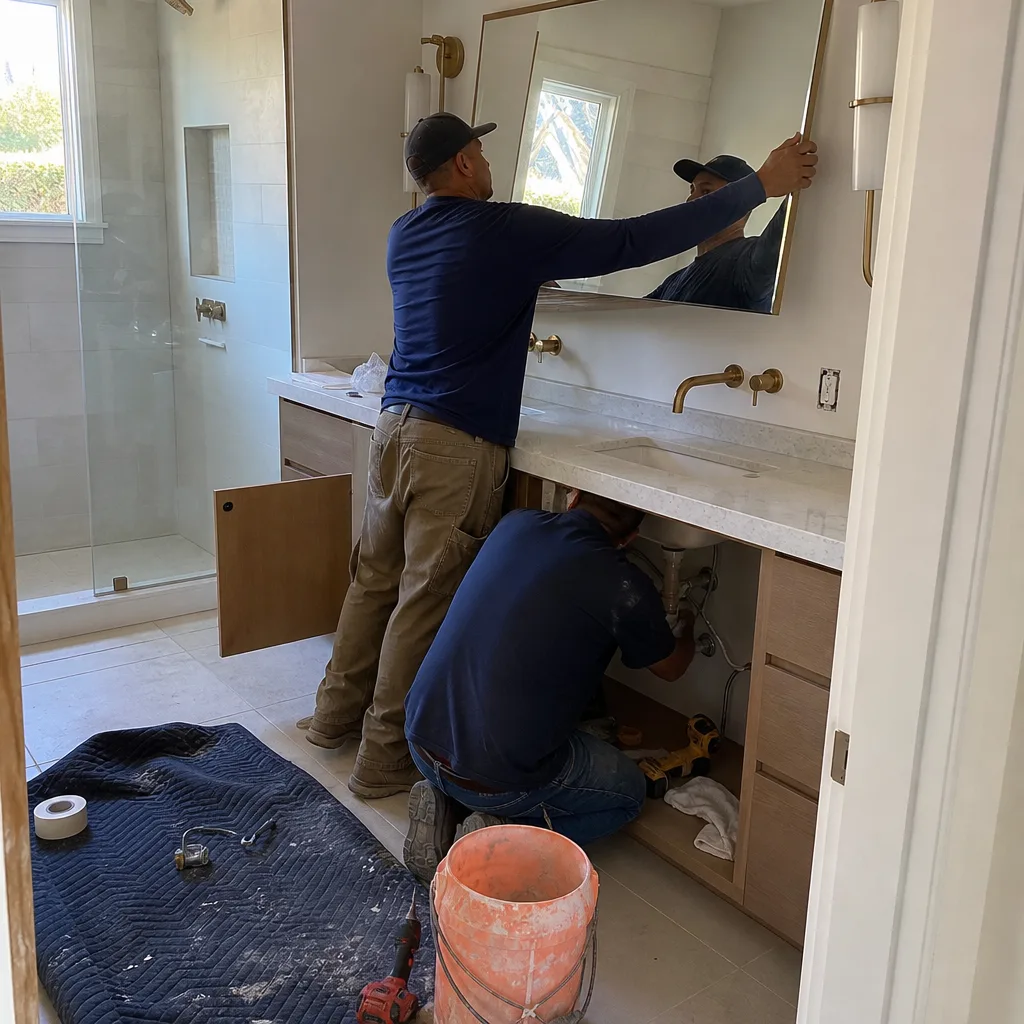
Here’s the symptom picture we hear most often on first calls. The kitchen that shipped with your Boxabl was built to a tolerance, not to your family. The laminated countertops show delamination at the edges within the first two years of daily use, cabinet hinges that were never meant for constant open-close cycles start to sag, and the 30-inch sink basin crowds every pot you own. What starts as a nuisance becomes a daily negotiation with your own home. Before you start pricing full replacements, know this: Elmstead Remodeling San Francisco is an independent contractor, not affiliated with Boxabl, but we’ve worked inside enough of these units to know exactly what the factory installed, what fails first, and what to put back in its place that will actually hold up.
Which Boxabl Models This Applies To

Boxabl’s Casita product line, which accounts for the overwhelming majority of units shipped to California buyers, uses a standardized kitchen core: a galley layout with a 24-inch base cabinet bank, a 30-inch sink base, and an upper cabinet run tied to factory mounting rails behind the wall panels. If you’re in a Casita, the measurements are almost certainly identical to what we’ve worked with in other San Francisco units. If you have one of the larger prototype or custom-ordered units, the countertop run length changes, but the mounting hardware and cabinet depth generally do not. Check the sticker inside the sink base door or on the back panel of the upper cabinet: you’re looking for a four-digit production code, and the second digit tells you the cabinet series. If that sticker is missing, measure the depth of your current base cabinet. Boxabl units run 24 inches deep, not the 25 1/2-to-26-inch depth of standard residential cabinetry. That quarter-inch difference is why off-the-shelf box-store cabinets leave a gap against the wall or force shims that look like an afterthought.
For Boxabl kitchens specifically, we lean toward aftermarket cabinets from KraftMaid or Wellborn over trying to source OEM replacements. The factory cabinets are functional but built to a price point, and sourcing direct from Boxabl can take weeks. KraftMaid’s ready-to-assemble line, by contrast, offers the same 24-inch depth with better hinge hardware, full-extension drawer glides, and a warranty you can register by name. The compatibility gotcha most owners don’t know: Boxabl wall panels are steel-framed with a composite core, so cabinet mounting requires weight-distribution rails or toggle anchors rated for the panel thickness, not wood studs. We’ve seen DIY cabinet installs in Boxabl units where upper cabinets pulled away from the wall within months because someone used drywall anchors. Your existing mounting points are reusable; new anchor points are not the place to guess. Where counters are concerned, Cambria and Silestone quartz slabs cut to your exact run length are both options we spec regularly for Boxabl kitchens in the Bay Area – they’ll take the morning commute coffee ring and the toddler’s art projects without the edge delamination the factory laminate shows within two years.
Styles & brands we work with







Signs Your Boxabl Kitchen Remodeling Is Failing
- Countertop edge delamination at the sink seam or front lip. The factory laminate counters on Boxabl units use a rolled edge profile that separates when water sits at the seam. If you can feel the substrate under the laminate edge, water is already inside, and patching won’t hold. This is the most common failure we see in San Francisco units within the first three years.
- Cabinet doors sagging more than a quarter inch at the outside corner. Factory hinges on Boxabl cabinets are euro-style cup hinges with limited adjustment range. When they sag, it’s usually because the mounting screws have stripped the composite core. Cranking them back up is temporary; the real fix is re-anchoring with proper toggles and switching to soft-close hinges. We see this most in homes near the Sunset District, where coastal humidity cycles stress the composite paneling faster than inland units.
- Sink base cabinet swelling or showing water staining at the toe kick. The factory sink is an undermount with a foam seal that degrades. Water goes under the sink rim, runs down the cabinet interior, and sits at the base. Left alone, the cabinet box loses structural integrity and the counter loses its bearing point. This is the repair that turns into a remodel once you see what’s behind the toe kick.
- Drawer glides sticking or popping out of the track entirely. Boxabl’s factory glides are side-mount, light-duty, and mounted to composite with screws that back out under repetition. If a drawer drops at the front when you pull it, the glide is already separating from the cabinet wall. Continued use just enlarges the hole and pushes you from a glide replacement into a full cabinet box replacement.
- A kitchen layout that fights you every single day. This is the failure that has nothing to do with a broken part and everything to do with the space not matching how your family cooks. The factory galley in a Casita is efficient but narrow, with counter space that can’t hold a cutting board and a drying rack at the same time. Most San Francisco homeowners we talk to are not replacing a broken kitchen so much as a kitchen whose design never anticipated their actual life.
Replacement Cost & What’s Included

In San Francisco, a full Boxabl kitchen remodel runs $16,520 to $53,100. On the lower end of that range, you’re looking at a cabinet-and-counter refresh: new doors and drawer fronts if the boxes are sound, new hardware, and a quartz or solid-surface counter replacement. On the upper end, you’re reconfiguring the entire galley: removing the factory peninsula where present, adding an island or expanding the counter run, replacing all cabinet boxes, new sink and fixtures from Kohler or Moen, and a backsplash installation that runs $945 to $2,950 depending on tile choice. Kitchen cabinet installation alone in a Boxabl runs $4,720 to $15,340, and countertops specifically run $2,360 to $7,670. The spread in those numbers comes down to material selection and whether we’re working with the existing mounting points or building new weight-distribution rails because the wall condition changed.
What you get for those numbers is a written price before any work starts. Not an estimate that grows after the crew arrives, not a range that shrinks once you sign. Graham Stein writes out the line items – cabinets, counters, sink, fixtures, tile, labor, permit fees if the scope requires them – and you see it all before a single tool comes off the truck. The 365-Day Done Right Promise covers the whole project: if something isn’t done right after we leave, we come back and make it right. That includes the photo of the clean-up we take before we walk out the door, the drop cloths and shoe covers that go down before we start, and the quiet hours we keep so nap time stays nap time.
See the difference
 Before
 After
After Before
 After
After Before
 After
AfterDIY or Call Us?
You can safely check a few things yourself: pull a drawer and look at the glide mounting screws, run your finger along the countertop seam at the sink to feel for separation, and open every cabinet door to see which ones sag. What you’re looking for is information, not a repair. Where DIY goes wrong in a Boxabl kitchen is structural: the wall panels are not wood-stud construction, the countertops are load-bearing across a specific span, and the plumbing and wiring are run through channels in the wall assembly. If you drill into the wrong place, you’re not patching drywall – you’re patching a composite panel that is part of the home’s structural envelope. The same goes for any countertop removal that involves the sink; disconnecting plumbing in a compact kitchen with limited access is not the place to learn. Safety isn’t abstract here. The electrical runs behind the cabinet backs are closer to the surface than they’d be in a conventional framed home. We tell every San Francisco Boxabl owner the same thing: check what you want to check, write down what you find, and call us to do the rest. (831) 480-4497. Tell me what the room needs to do, and we’ll figure out the rest from there.
FAQs
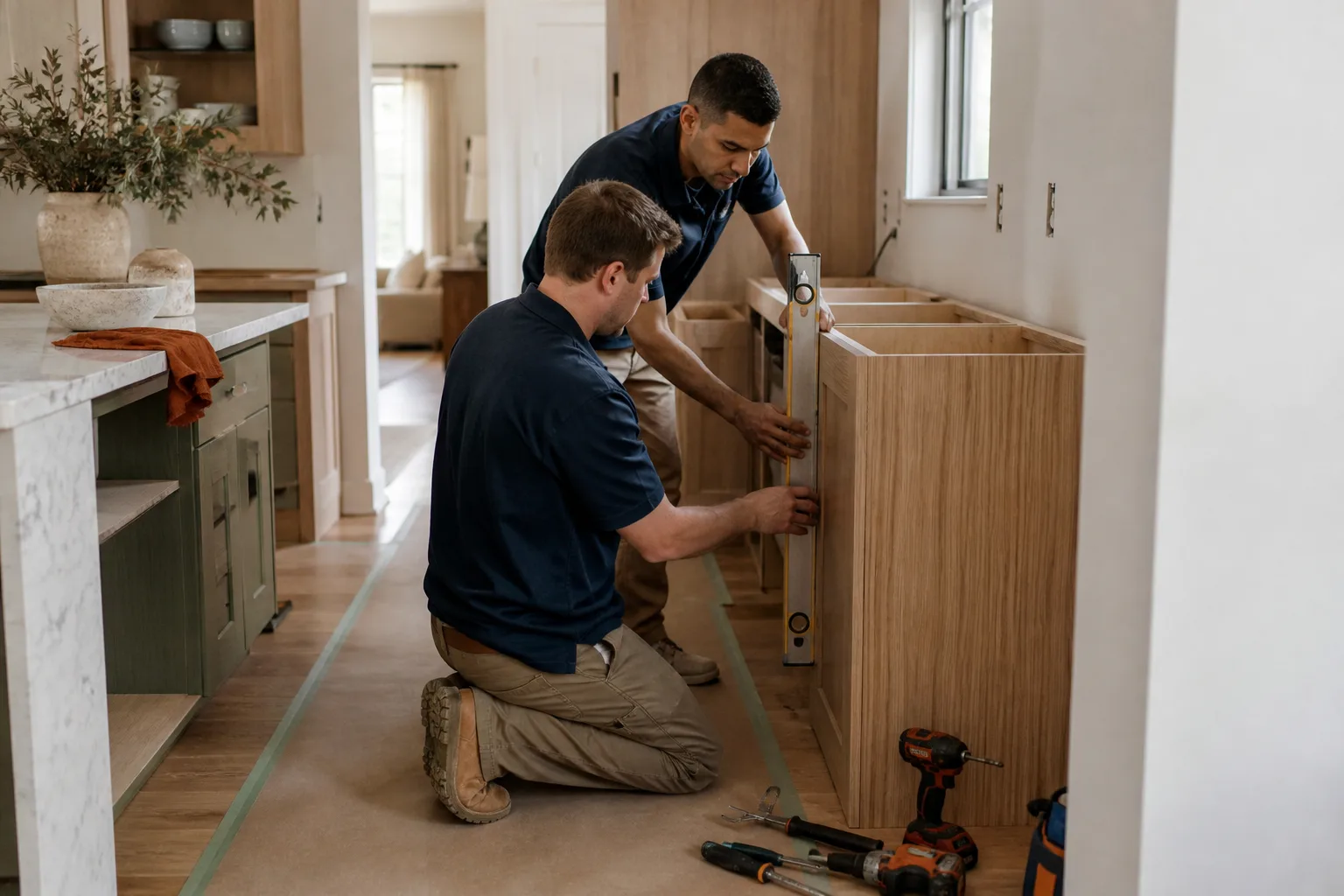
A Boxabl kitchen remodel done with aftermarket cabinets from KraftMaid or Wellborn, quartz counters from Cambria or Silestone, and properly anchored mounting rails will last 15 to 25 years under normal use in San Francisco’s climate, with the countertops often outliving the cabinets and fixtures wearing first at the faucet. The factory kitchen, by contrast, typically shows delamination and hinge failure within two to three years. Coastal units near Ocean Beach or the Sunset see faster wear on composite cabinet boxes due to moisture cycling. Call (831) 480-4497 if you want us to look at your unit specifically – the estimate is free.
Yes, in many cases we can repair rather than replace, and that repair work typically costs 30% to 50% of a full replacement. Hinge re-anchoring, drawer glide replacement, and counter seam resealing are all repairs we do regularly. Where we draw the line is structural: once a cabinet box has swelled from water damage or a countertop substrate has delaminated, the repair won’t hold, and spending money on it just defers the replacement. We’ll tell you which one you’re looking at before any work is scheduled.
A full Boxabl kitchen remodel in San Francisco takes two to three weeks from first cabinet removal to final clean-up, depending on whether we’re reconfiguring the layout or replacing in place. A cabinet-and-counter-only refresh usually lands around one to two weeks. We’ll give you a written schedule with the written price, and we keep quiet hours during children’s sleep times so the home stays livable while we’re in it.
We stock cabinet hinge hardware, drawer glides, mounting toggles rated for Boxabl’s composite wall panels, and common sink and faucet components on our trucks, because those are the parts that fail predictably. For cabinet boxes, countertops, and fixture selections from Kohler, Moen, or Grohe, we order to your exact measurements and selections, and lead times in San Francisco are typically one to three weeks depending on the manufacturer and your material choice. Call (831) 480-4497 and we’ll tell you what’s in stock, what needs ordering, and when it all lands.
Contact Elmstead Remodeling San Francisco for Boxabl Kitchen Work
If you own a Boxabl in San Francisco and the kitchen needs attention, call (831) 480-4497. A live person answers, 24/7, not a voicemail tree. We’ll schedule a walkthrough, measure your specific unit, and give you a written price for the work before anything starts. Whether it’s a cabinet that won’t close square or a full galley reconfiguration with an island, we’ll name the products, name the steps, and leave your home cleaner than we found it with the photo to prove it. Based in San Francisco and serving the surrounding areas, Graham and the Elmstead team work on Boxabl kitchens from the Sunset District to Bernal Heights and everywhere in between.
Written by Graham Stein, Owner, Elmstead Remodeling San Francisco at Elmstead Remodeling San Francisco, serving San Francisco and nearby areas.


