

Last updated October 15, 2026








Free written scope consultation - allowances, timeline, and change-order rules on paper before a single trade is scheduled
Construction Cost Breakdown: The San Francisco Homeowner’s Reference for 2026
A mid-range kitchen remodel in San Francisco now averages $80,000 to $130,000 according to local contractor data, roughly 40% above the national median. That gap isn’t a mystery, and it isn’t the result of contractors simply charging more because they can. Almost all of it traces back to three line items: labor rates driven by the Bay Area’s cost of living, permit fees calculated on project valuation by the Department of Building Inspection, and the practical complexity of working in occupied homes on narrow urban lots. This guide breaks down exactly where the money goes, by category, by material tier, and by project type, using 2026 figures gathered from active San Francisco remodeling work.
Quick Answer
In 2026, a full kitchen remodel in San Francisco typically costs $80,000 to $130,000, a primary bathroom $45,000 to $85,000, a 400-square-foot ADU $280,000 to $420,000, and a seismic retrofit $40,000 to $90,000. Labor accounts for roughly 40 to 50 percent of most project budgets, materials 30 to 40 percent, and permits plus design fees the remainder. Getting a written, fixed-price contract before any work starts is the single most effective way to control these costs.
Styles & brands we work with







Table of Contents
- Where the Money Actually Goes: Labor, Materials, and Permits
- Kitchen Remodel Costs in San Francisco: Line by Line
- Bathroom Remodel Costs: What a $45,000 to $85,000 Project Includes
- ADU Addition Costs: The Full Breakdown for 2026
- Seismic Retrofit Costs for the Older San Francisco Home
- Named-Brand Materials vs. Builder-Grade: The Dollar Difference
- The Cost of Working in an Occupied Home
- Why a Written, Fixed-Price Contract Protects You
Where the Money Actually Goes: Labor, Materials, and Permits
Every San Francisco remodel breaks down into three buckets, and the proportions stay surprisingly consistent across project types. Labor runs 40 to 50 percent of a typical budget. Materials land between 30 and 40 percent. Permits, design fees, and engineering take the remaining 10 to 20 percent. If a bid comes in dramatically outside these ratios, that is the first thing to examine.
San Francisco labor rates in 2026 sit between $85 and $150 per hour for licensed trades, depending on the trade and the complexity of the work. A journeyman carpenter costs less than a licensed electrician or plumber, and both cost less than a general contractor’s site supervision time, which runs $120 to $180 per hour. Union shops, which are common in San Francisco, trend toward the higher end. Non-union licensed contractors typically run 10 to 20 percent below union rates. The city’s prevailing wage requirements on certain larger projects also push labor costs upward, and those costs get passed through to the homeowner.
Materials are the second major bucket, and this is where bid comparison gets tricky. Two contractors can quote the same project with a $20,000 difference and both be telling the truth. The difference is almost always in material specification: one is quoting a stock vanity from a home center, the other a Wellborn cabinet line with dovetailed drawers and a documented warranty. We’ll return to this in the materials section below.
Permits are the third bucket, and San Francisco’s Department of Building Inspection (DBI) calculates its fees on the declared valuation of the project, as outlined in our Construction Permits, Codes & Inspections in CA: What You Need to Know. For a $150,000 kitchen remodel, permit fees alone typically land between $3,000 and $6,000 before anyone pulls a nail. That number surprises homeowners who are used to the flat-fee permit systems of smaller municipalities. It is a real budget line in San Francisco, and a legitimate contractor will show it to you as a separate item, not bury it in a lump sum. Some projects also require separate plumbing and electrical permits, which add their own fees, and if the property is subject to San Francisco’s planning review for historic or neighborhood character, a planning application adds another $500 to $2,000 depending on the scope.
Why So Much Higher Than the National Average?
The 40 percent premium over national medians is not arbitrary. San Francisco’s minimum wage is among the highest in the country, and skilled trades command wages well above minimum. The city’s permitting process is more rigorous and more expensive than nearly anywhere else in California, and the process itself, though unavoidable, adds time to every project. Narrow lots and shared walls mean deliveries must be scheduled carefully, materials staged in tight spaces, and work sequenced around the family’s daily life. All of that is labor time, and labor time is money. The honest contractor names these costs as line items; the dishonest one hides them and then issues change orders later.
Kitchen Remodel Costs in San Francisco: Line by Line
A mid-range kitchen remodel in San Francisco, defined as a full gut and rebuild of a 150 to 200 square foot kitchen in a typical Marina, Sunset, or Noe Valley home, runs $80,000 to $130,000 in 2026. Here is where the money goes, line by line.
Labor: $35,000 to $55,000
This covers demolition, rough carpentry, electrical, plumbing, drywall, tile setting, cabinet installation, countertop fabrication and installation, painting, and project supervision. Electricians and plumbers in San Francisco are union-heavy trades, and their rates reflect it. A full kitchen electrical rewire, which most San Francisco remodels need because the original wiring predates modern code requirements, runs $6,000 to $12,000 on its own.
Cabinetry: $15,000 to $35,000
Stock cabinets from a home center run $5,000 to $10,000 for a typical kitchen. Semi-custom lines from manufacturers like KraftMaid or Wellborn run $15,000 to $25,000. Fully custom cabinetry built by a local shop runs $30,000 to $50,000. The difference is in the joinery, the drawer hardware, the finish durability, and the warranty. A Wellborn or KraftMaid cabinet carries a manufacturer’s warranty that travels with the home if you sell; builder-grade cabinets from a big-box store typically carry a one-year limited warranty or none at all.
Countertops: $5,000 to $12,000
Quartz from Cambria, Silestone, or Caesarstone runs $80 to $150 per square foot installed, and a typical San Francisco kitchen uses 40 to 60 square feet. Natural stone like marble or quartzite runs higher, $120 to $250 per square foot installed. Laminate runs $30 to $50 per square foot but is rare in San Francisco remodels at the mid-range level.
Appliances: $8,000 to $20,000
A mid-range appliance package, meaning brands like Bosch, KitchenAid, or Fisher & Paykel across a range, refrigerator, dishwasher, and ventilation, lands between $8,000 and $15,000. Higher-end lines from Sub-Zero, Wolf, or Miele push past $20,000 quickly. Appliance costs are one of the easiest line items to control because the homeowner selects them directly, but a contractor who quotes a remodel without asking about appliance preferences is guessing.
Flooring and Backsplash: $4,000 to $9,000
Tile for a kitchen floor and backsplash runs $15 to $40 per square foot installed for ceramic or porcelain, and $40 to $100 per square foot for natural stone. Hardwood flooring, if the kitchen ties into an adjacent living space, runs $12 to $25 per square foot installed for site-finished oak.
Permits and Design: $5,000 to $15,000
DBI permit fees for a mid-range kitchen land at $3,000 to $6,000 as noted above. Architectural and design drawings, which San Francisco requires for any project that changes the layout, run $3,000 to $10,000 depending on the designer or architect and the complexity of the plan. Some kitchens trigger planning review if the home is under the city’s historic preservation protections or in a neighborhood like Presidio Heights or Pacific Heights where character review is more stringent.
Bathroom Remodel Costs: What a $45,000 to $85,000 Project Includes
A primary bathroom remodel in San Francisco ranges from $45,000 to $85,000 in 2026, while a guest or hall bathroom runs $30,000 to $55,000. The spread reflects square footage, fixture selection, and whether the project moves plumbing lines or keeps the existing layout.
Labor: $20,000 to $40,000
Bathroom labor covers demo, plumbing rough-in, electrical, waterproofing, tile setting, fixture installation, and supervision. Moving a toilet, shower, or vanity drain adds $2,000 to $5,000 per fixture because of the additional framing and plumbing work. Keeping the layout as-is is the single biggest cost control in a bathroom remodel.
Waterproofing and Tile Work: $8,000 to $20,000
This is the line item that separates a bathroom that lasts 30 years from one that fails in five. A Schluter waterproofing system, properly installed, costs $2,000 to $4,000 in materials and labor for a typical shower and carries a documented manufacturer’s warranty. A shower built with cement board and a rubber pan, which was standard practice a generation ago, costs less upfront but is where we see more failures in San Francisco’s older homes, especially in the Sunset and Richmond districts where fog moisture and older framing put extra stress on water barriers.
Tile installation runs $15 to $40 per square foot for ceramic or porcelain, $40 to $100 for natural stone. A typical San Francisco bathroom uses 100 to 150 square feet of tile across the floor, shower walls, and wainscoting.
Fixtures: $4,000 to $12,000
Mid-range fixtures from Kohler, Moen, or Grohe run $4,000 to $8,000 for a full bathroom set, including the toilet, vanity, faucets, shower head, and tub or shower pan. Higher-end fixtures can push past $12,000. These are named-brand products with manufacturer warranties the homeowner can verify directly, and the warranty travels with the home.
Vanity and Countertop: $3,000 to $8,000
A Wellborn or KraftMaid vanity runs $2,000 to $5,000 depending on size and finish. The countertop, typically quartz from Cambria or Silestone, adds another $1,000 to $3,000. A home-center vanity with a cultured marble top runs $800 to $1,500 but shows wear within a few years.
Permits: $1,500 to $4,000
DBI fees for a bathroom remodel are lower than kitchen fees because the valuation is lower, but they still run $1,500 to $4,000 for a mid-range project, plus a separate plumbing permit if the work moves or replaces drain lines.
For a deeper look at bathroom work specifically, our Bathroom Remodeling in San Francisco guide covers the process from first design meeting to final walkthrough.
ADU Addition Costs: The Full Breakdown for 2026
Accessory dwelling units, or ADUs, are the most expensive and most variable project type in San Francisco. A 400-square-foot detached ADU runs $280,000 to $420,000 in 2026, or $700 to $1,050 per square foot. A garage conversion ADU runs slightly lower, $250,000 to $350,000, because the shell already exists, but the cost per square foot is often higher because of the structural work required to bring a garage up to residential code.
Why ADUs Cost So Much Per Square Foot
The per-square-foot number looks alarming compared to new construction in other markets, but ADUs carry fixed costs that don’t scale down. A 400-square-foot ADU still needs a full electrical service, a full plumbing system, a kitchen, a bathroom, heating, insulation, and a foundation. Those systems cost almost as much in a small ADU as they do in a larger home addition. The result is a higher cost per square foot than a larger project, not because the work is overpriced but because the fixed costs are spread across fewer square feet.
Labor: $120,000 to $180,000
ADU labor includes excavation, foundation work, framing, roofing, electrical, plumbing, HVAC, drywall, tile, cabinetry, and finish work, plus project supervision across what is typically a 9 to 14 month build. San Francisco’s ADU process also requires more coordination with DBI than a typical remodel because the unit is a separate dwelling, which means additional inspections at each phase.
Materials: $90,000 to $150,000
Foundation and framing lumber have been volatile for the past several years, and 2026 prices have stabilized but remain elevated. Roofing, windows, insulation, drywall, and paint all run at premium prices in San Francisco because of delivery costs and the logistics of getting materials into neighborhoods like Glen Park or Bernal Heights where street parking for a delivery truck means careful scheduling. Exterior siding from James Hardie runs $8 to $12 per square foot installed and carries a documented product warranty.
Permits, Design, and Engineering: $25,000 to $50,000
ADU permits are the most expensive in the San Francisco residential market. DBI fees, planning fees, school district fees, and utility connection fees can total $25,000 to $50,000 depending on the project. San Francisco also requires architectural drawings and, for detached units, structural engineering and a soils report. Design and engineering fees for an ADU run $15,000 to $30,000.
For a wider view of how a contractor manages projects of this scale, see our General Contractor in San Francisco page.
Seismic Retrofit Costs for the Older San Francisco Home
Seismic retrofitting runs $40,000 to $90,000 for a typical San Francisco single-family home in 2026. The range depends on the age of the house, the foundation type, and whether the work is a simple shear-wall and bolting retrofit or a full addition of steel moment frames.
What the Work Actually Involves
A basic retrofit, in the $40,000 to $55,000 range, includes bolting the sill plate to the foundation, adding plywood shear walls at the cripple wall level, and installing hold-downs at key corners. A fuller retrofit, in the $60,000 to $90,000 range, adds steel moment frames at garage openings, additional foundation work where the existing concrete is degraded, and strapping for the water heater and other fixtures.
Why the Range Is So Wide
Homes in the Sunset and Richmond districts, which sit on sandy soils and were largely built before 1940, often have foundations that need repair work before the seismic retrofit can even begin. A home in Noe Valley or the Mission may sit on rockier soils and have a more straightforward path. The condition of the foundation, which is only knowable after an engineer evaluates the crawlspace, is the biggest cost variable. A contractor who quotes a seismic retrofit without an engineer’s report is estimating, not pricing.
Expected Costs by Line Item
- Engineering and permits: $5,000 to $12,000. San Francisco requires stamped engineering drawings for seismic work, and DBI fees add another $2,000 to $5,000.
- Foundation work: $8,000 to $25,000. This is the most variable line item, driven by the condition of the existing concrete.
- Shear walls and bolting: $12,000 to $25,000. Plywood shear walls, anchor bolts, and hold-downs at the cripple wall level.
- Steel moment frames: $10,000 to $25,000 per frame. Most San Francisco homes need one or two frames at garage openings.
- Cleanup and finish work: $3,000 to $8,000. Crawlspace work is dusty, and the home needs to be left right.
Named-Brand Materials vs. Builder-Grade: The Dollar Difference
The largest single difference between a $60,000 kitchen and a $110,000 kitchen in San Francisco is material specification, and the difference shows up in writing. Named-brand materials from manufacturers like Schluter, James Hardie, Marvin, and Benjamin Moore carry documented warranties that the homeowner can hold in their hand. Builder-grade substitutes, often sourced from home centers or builder supply warehouses, carry limited warranties or none at all.
What the Dollar Difference Looks Like
- Cabinets: KraftMaid or Wellborn semi-custom runs $15,000 to $25,000 for a typical kitchen and carries a lifetime limited warranty on the cabinet boxes and drawer hardware. Builder-grade stock cabinets run $5,000 to $10,000 and typically carry a one-year warranty.
- Shower waterproofing: A Schluter system runs $2,000 to $4,000 installed and carries a manufacturer’s warranty on the waterproofing assembly. A traditional cement-board and rubber-pan shower runs $800 to $1,500 but has no third-party warranty, and failures appear within 5 to 10 years in San Francisco’s older homes.
- Exterior siding: James Hardie fiber cement runs $8 to $12 per square foot installed with a 30-year product warranty. Vinyl siding, which is rare in San Francisco but occasionally appears in budget bids, runs $4 to $6 per square foot and has a shorter expected service life.
- Windows and doors: Marvin windows run $1,200 to $2,500 per opening installed and carry warranties that transfer to a new owner. Builder-grade vinyl windows run $500 to $900 per opening and carry shorter, more conditional warranties.
- Paint: Benjamin Moore Aura or Regal Select runs $75 to $100 per gallon and is a known quantity in terms of coverage, durability, and low-VOC formulation. Builder-grade paint runs $30 to $45 per gallon and requires more coats, which eats the savings in labor time.
The Hidden Cost of the Cheaper Bid
The builder-grade path saves $20,000 to $40,000 on a typical kitchen remodel upfront. But the expected service life of builder-grade cabinets, fixtures, and waterproofing is roughly half that of named-brand materials in heavy daily use. When the countertop delaminates or the drawer slides fail in year six, the replacement cost comes out of pocket because the warranty has expired. The named-brand path costs more upfront, but the warranties mean the manufacturer stands behind the product, and the product itself is built for a longer service life. In the context of a San Francisco remodel, where the labor cost to install materials often exceeds the material cost itself, paying more for materials that last twice as long is not luxury spending. It is the cheaper option over a ten-year horizon.
The Cost of Working in an Occupied Home
Most San Francisco remodels happen in homes that are occupied by the family during construction. This is not a footnote to the project; it is a substantial cost driver that shows up in three specific ways: dust containment, daily cleanup, and sequencing.
Dust Containment Systems
A contractor working in an occupied home must build containment barriers to keep construction dust out of the living areas, and those barriers take labor time to install, maintain, and remove. For a kitchen remodel in an occupied home, a proper containment system, meaning plastic sheeting, zippered doorways, and negative air pressure in the work zone, runs $1,500 to $4,000. A contractor working in an empty house does not bear this cost. A bid that does not include containment for an occupied-home job is either cutting a corner or planning to add the cost later.
Daily Cleanup Hours
Leaving a construction site at the end of each day, rather than cleaning once a week, adds 30 to 60 minutes of labor per day. Over the course of a 12-week kitchen remodel, that is 30 to 60 hours of labor, which at San Francisco rates adds $3,000 to $9,000 to the project. This is money well spent, and it is a cost that should be named, not hidden. The crew needs to vacuum, wipe down surfaces, and stage tools so the family can use the rest of the house comfortably each evening.
Sequencing That Keeps the Home Functional
In an empty house, a contractor can demo the whole kitchen at once and work through the rebuild without stopping. In an occupied home, the work must be sequenced so the family has a working bathroom at all times, or a temporary kitchen set up in the garage or dining room. This sequencing adds labor time because the crew is working around the family’s daily routine rather than straight through the job. For a primary bathroom remodel, it often means building a temporary shower or coordinating so the family has access to another bathroom. These costs run $2,000 to $6,000 and are the difference between a project that is bearable and one that strains the household.
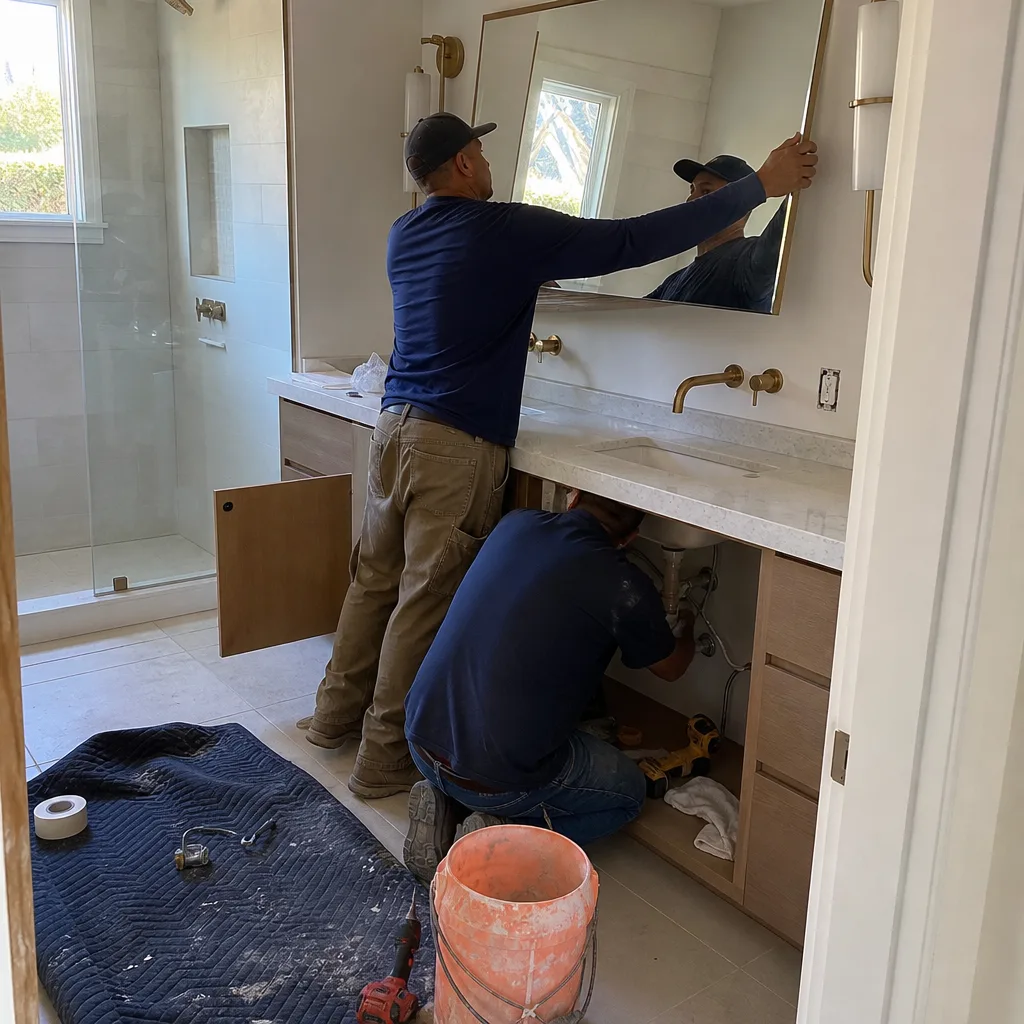
We name these costs because families should understand what they are paying for. The drop cloths on the floors, the shoe covers at the door, and the daily cleanup are not gestures; they are line items that protect the home during construction, and they protect children and pets who live in the home while the work happens. A contractor who hides these costs in the bid is planning to cut them, and the family pays for that in dust on the bookshelves and construction debris in the hallway.
Why a Written, Fixed-Price Contract Protects You
A fixed-price contract is a written document that names the scope of work, the materials to be used, and the total price before any work starts. A cost-plus contract, by contrast, charges the homeowner for the contractor’s actual costs plus a percentage markup, which means the final price is unknown until the work is done. A time-and-materials contract charges for labor hours and materials as they are used, with no total price stated at all.
In our experience in San Francisco, the most common source of homeowner frustration is not the work itself but the surprise at the end: a final bill that is 20 or 30 percent higher than the estimate because the original number was not a fixed price. A legitimate contractor gives a written price before any work starts, and that price holds unless the scope of work genuinely changes. If the homeowner asks for something new, like additional cabinetry or a different tile, that is a change order, and it should be priced and agreed to in writing before the additional work begins.
What a Legitimate Change Order Process Looks Like
- The change is documented in writing. A verbal agreement to add a window or move a wall is not a change order. It should describe exactly what is being added, removed, or changed.
- The price of the change is stated before the work begins. The homeowner should know what the change costs before approving it, not after.
- The impact on the schedule is stated. A change that adds two weeks to the project should be acknowledged in writing.
- The original fixed price remains fixed for everything outside the change. A change order does not reopen the entire contract.
A contractor who will not give a written price before work starts is asking the homeowner to absorb the financial risk of the project, a choice explored in our DIY vs Professional Construction: The San Francisco Homeowner’s Decision Guide. In San Francisco, where labor rates are high and surprises are common in older homes, that risk is substantial. The fixed-price contract is not a luxury; it is the baseline standard for a professional remodeling relationship. At Elmstead Remodeling San Francisco, every project gets a written price before any work starts, and it holds.
For more on how a full kitchen project comes together from first measurement to final walkthrough, see our Kitchen Remodeling in San Francisco guide.
Common Mistakes to Avoid
- Comparing bids that are not scoped the same way. A $60,000 kitchen bid that uses builder-grade cabinets and a $110,000 bid that uses Wellborn cabinetry and a Schluter waterproofing system are not competing for the same project. Ask each contractor to itemize materials by brand and model.
- Accepting an estimate instead of a fixed price. An estimate is a guess; a written fixed price is a commitment. Before any work starts, ask whether the number is an estimate or a contract price.
- Skipping the permit. Unpermitted work in San Francisco becomes a problem when you sell the house, and DBI can require the work to be exposed for inspection, which means tearing out finished surfaces. The permit fee is a small price for a legal project.
- Choosing materials on price without checking the warranty. A $30 per gallon paint that needs three coats costs more in labor than a $75 per gallon paint that covers in two. Read the warranty terms before choosing.
- Not asking about containment and cleanup before signing. If the bid does not mention dust containment, shoe covers, or daily cleanup, ask directly. The answer matters for families with children and pets.
- Hiring a contractor without checking San Francisco references. A contractor who has worked in the Marina, Sunset, or Noe Valley understands the permitting process, the parking logistics, and the building stock. Ask for references from completed projects in similar neighborhoods.
- Assuming the lowest bid is the best value. The false economy of the low number is real. A bid that is 30 percent below the others is low for a reason, and the reason usually shows up as change orders, material substitutions, or work that fails within a few years.
See the difference
 Before
 After
After Before
 After
After Before
 After
AfterWhen to Call a Professional
Remodeling costs in San Francisco are high enough that a mistake is expensive, and the city’s older housing stock hides surprises that only reveal themselves after demolition begins. If your project involves moving plumbing or electrical lines, if your home was built before 1940, if you are planning an ADU, or if your project requires a DBI permit, a licensed general contractor should be involved. A professional contractor can identify structural issues before they become change orders, navigate the permitting process, and give a written price that holds. For more guides & resources, visit our blog, or call Elmstead Remodeling San Francisco at (831) 480-4497 to schedule your free estimate. General contracting, kitchen remodeling, bathroom remodeling, and whole-home remodeling are the services we provide, and every project carries a written price before any work starts.
For an overview of our services and how we approach a project, start at the Elmstead Remodeling San Francisco home page.
Frequently Asked Questions

A mid-range kitchen remodel in San Francisco costs $80,000 to $130,000, while a higher-end project with custom cabinetry and premium appliances can run $150,000 to $200,000 or more. The spread depends on material specification, appliance selection, and whether the layout changes. Call (831) 480-4497 for a written price on your specific kitchen.
DBI permit fees for a $150,000 kitchen remodel run $3,000 to $6,000, and bathroom permits run $1,500 to $4,000. ADU permits, including planning, school district, and utility fees, can reach $25,000 to $50,000. These fees are calculated on project valuation and are a standard budget line in San Francisco.
San Francisco remodeling costs run roughly 40 percent above national medians because of three factors: Bay Area labor rates, which run $85 to $150 per hour for licensed trades, DBI permit fees that are calculated on project valuation, and the practical complexity of working in occupied homes on narrow urban lots. These are structural cost drivers, not contractor markup.
A fixed-price contract states the total price before any work starts and holds unless the scope changes through a written change order. A cost-plus contract charges the homeowner for the contractor’s actual costs plus a markup, which means the final price is unknown at the start. We give a written, fixed price on every project before any work begins.
A typical San Francisco kitchen remodel runs 10 to 14 weeks from demolition to final walkthrough. The permitting process adds 4 to 12 weeks before construction begins, depending on the scope and whether planning review is required. A bathroom remodel runs 4 to 8 weeks, and an ADU runs 9 to 14 months.
Named-brand materials from manufacturers like Schluter, James Hardie, Marvin, and Benjamin Moore cost more upfront but carry documented warranties and longer expected service lives. Builder-grade materials save $20,000 to $40,000 on a kitchen remodel but often need replacement within 5 to 10 years, at which point the savings are gone and the replacement labor is an added cost.
The Bottom Line
San Francisco remodeling costs are high for real reasons: Bay Area labor rates, DBI permit fees calculated on valuation, and the logistics of working in occupied homes on narrow lots. Understanding the cost drivers helps you evaluate bids accurately and avoid both overpaying and the false economy of the lowest number. The path to a fair price is a written, fixed-price contract with itemized materials, named-brand products with documented warranties, and a contractor who names the containment and cleanup costs rather than hiding them. Elmstead Remodeling San Francisco gives a written price before any work starts, and every project carries the 365-Day Done Right Promise. Call (831) 480-4497 to schedule your free estimate.
Written by Graham Stein, Owner at Elmstead Remodeling San Francisco, serving San Francisco since 2005.


