

Last updated October 15, 2026








Free written scope consultation - allowances, timeline, and change-order rules on paper before a single trade is scheduled
How to Hire a Construction Contractor in San Francisco: A Step-by-Step Guide
A California contractor’s license tells you they passed a test and carry a bond. It tells you almost nothing about whether they will leave your kitchen usable at the end of each workday, seal the work zone before they go home, or ask before moving your daughter’s homework off the counter. In San Francisco, where most remodeling happens inside occupied homes with children, pets, and neighbors behind shared walls, the standard advice to “get three bids and check the license” misses the questions that actually predict whether the next six weeks will be manageable or miserable. This guide walks through the specific, ordered process for evaluating contractors on the things that affect daily life, not just the finished product, and points to more guides & resources for homeowners managing active projects.
Quick Answer
To hire a construction contractor in San Francisco, verify the license classification matches your project on the CSLB website, request five written documents before signing anything (itemized bid, payment schedule, material spec sheet, lien waiver process, warranty terms), and interview each candidate about how they manage an occupied home: dust containment, tool storage, quiet hours, and clean-up. For a deeper look at local requirements, see The Complete Guide to Construction in San Francisco. Then read the bid for omissions and red flags before you ever discuss price.
Styles & brands we work with







Table of Contents
- Step 1: Verify the License on the CSLB Website (And Understand the Classification Letter)
- Step 2: Request These Five Written Documents Before Signing Anything
- Step 3: Ask Interview Questions That Reveal How They Treat an Occupied Home
- Step 4: How to Read a Bid for What It Omits
- Step 5: Red Flags Specific to San Francisco
- What Project Types Actually Cost in San Francisco
- How the Payment Schedule Should Be Structured
- What a Real Warranty Looks Like in Writing
Step 1: Verify the License on the CSLB Website (And Understand the Classification Letter)
The Contractors State License Board (CSLB) keeps a public database at cslb.ca.gov. Type in the license number or the contractor’s legal business name and you’ll see the license status, issue date, expiration date, workers’ compensation coverage, and any disciplinary actions. It takes under three minutes. Do this before you call anyone. Do not skip it because the contractor “seems professional.” A suspended license is not a technicality, it means the bond has lapsed and you have no recourse through the state if something goes wrong.
What most San Francisco homeowners miss: the letter at the end of the license number matters more than the number itself. A “B” classification (General Building Contractor) covers most remodeling work, including kitchens, bathrooms, and whole-home projects. A “C” classification is for specialty trades: C36 is plumbing, C10 is electrical, C54 is tile, C33 is painting and decorating. If you are hiring someone for a kitchen remodel that involves moving a gas line and rerouting electrical, and they only hold a C33 painting license, they cannot legally pull permits for that plumbing work. They can only subcontract it. Know the classification letter before you sign.
Here is the three-minute verification process:
- Go to cslb.ca.gov and click “Check a License.”
- Enter the license number or business name. Write down the classification letter.
- Confirm the status says “Active.” Confirm the business name on the license matches the name on the bid.
- Check the “Workers’ Compensation” field. If it says “Exempt” and the contractor has any employees on your job, you are the one exposed if someone gets hurt.
- Scroll to see if there are any disciplinary actions, citations, or license suspensions in the record.
In San Francisco, there is another layer. The city requires its own business registration with the Office of the Treasurer & Tax Collector, and any contractor doing work valued above certain thresholds may need additional city-specific compliance. A contractor who has done work in San Francisco before will not blink when you ask about this. A contractor who has never worked inside city limits may not have thought about it. That matters.
Step 2: Request These Five Written Documents Before Signing Anything
A verbal promise is not a contract term in California. It is a memory. The contractors worth hiring in San Francisco will hand you documentation without being asked twice. The ones who stall, shrug, or say “we’ll work it out as we go” are telling you something important about how the job will run. Request all five of these before you sign:
- The itemized bid. Not a single number on a napkin. A line-by-line breakdown of labor, materials, permits, and subcontractor costs. If a bid is one number with no breakdown, you cannot compare it to another bid and you cannot hold anyone to it later.
- The payment schedule. Written, dated, and tied to milestones, not to calendar weeks. “First payment at demo, second payment at rough-in inspection, final payment at final walkthrough” is a schedule. “25% every two weeks” is a red flag.
- The material spec sheet. This names the exact products going into the job: cabinet line and door style, countertop material and thickness, fixture brand and model number, flooring manufacturer. “Mid-grade cabinets” is not a spec. KraftMaid cabinetry with a specific door profile is a spec. Silestone countertops in a named color are a spec. Kohler fixtures with model numbers are a spec.
- The lien waiver process. This is the document trail that proves the contractor paid their subcontractors and material suppliers. Without it, a sub who never got paid can file a mechanics lien against your house in San Francisco even if you already paid the general contractor in full. The contractor should describe, in writing, how and when they will provide conditional and unconditional lien waivers at each payment milestone.
- The warranty terms in plain language. What is covered, for how long, and what the process is to make a claim. “We stand behind our work” is not a warranty. “One year on workmanship, with manufacturer warranties on all named materials, and a written process for submitting a claim within 30 days of noticing an issue” is a warranty.
Elmstead Remodeling San Francisco includes a written price before any work starts, every time. Not a range, not an estimate that grows after the crew arrives. A written price. That is the document that protects you, and it should be sitting in front of you before you ever hand over a deposit.
Step 3: Ask Interview Questions That Reveal How They Treat an Occupied Home
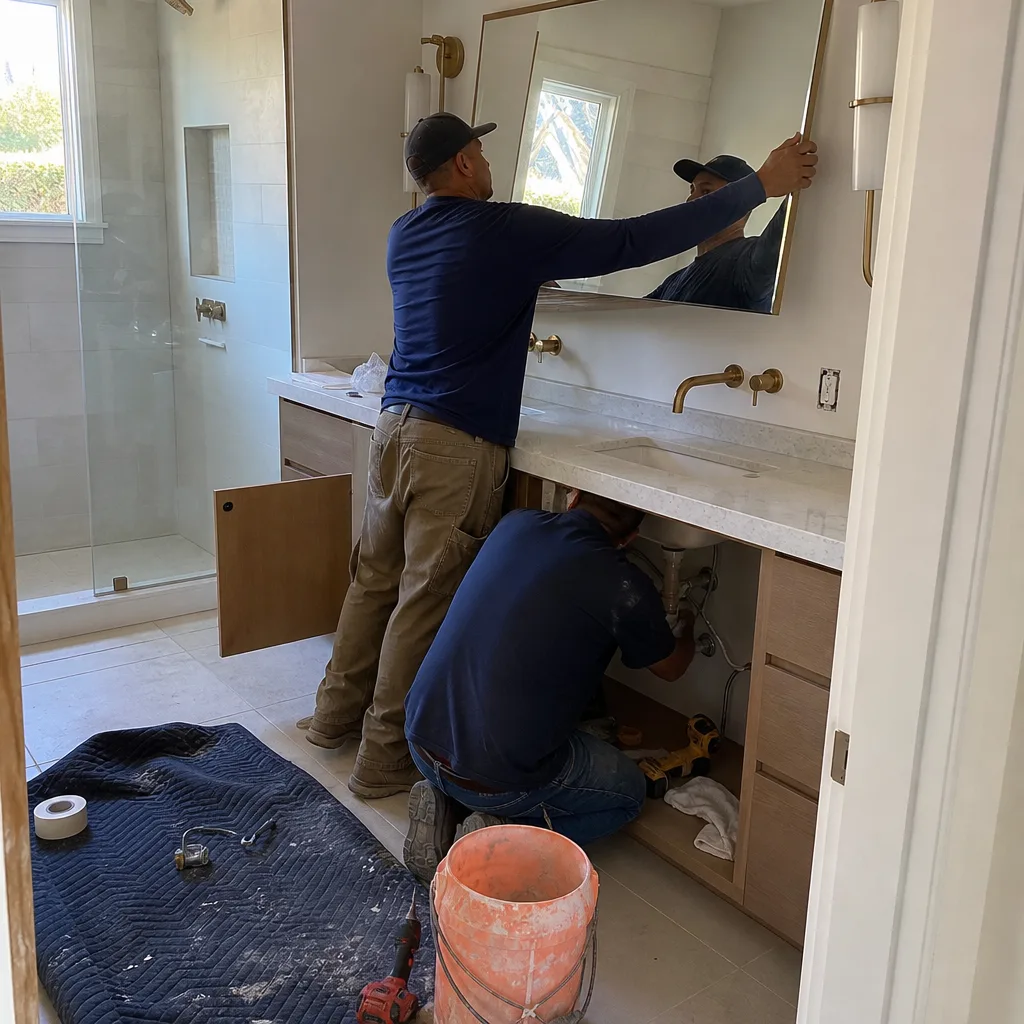
Most homeowners ask about timeline and budget. Those matter. But in San Francisco, where families live in the house during a kitchen or bathroom remodel in San Francisco, the questions that separate a careful contractor from a careless one are about daily life. A contractor who has thought through these answers has run jobs inside occupied homes before. A contractor who flinches has not, or has not cared to.
Ask these questions, in this order, and listen carefully to the answers:
- “Where do the tools and materials get stored overnight?” A good answer specifies a place: the garage, a locked trailer, a designated corner of the living room, sealed and covered. A bad answer is a pause followed by “wherever there’s room.”
- “What dust containment method do you use, and what does it look like at the end of every day?” Look for named methods: plastic sheeting and tape, ZipWall dust barriers, negative air machines for larger demo. Listen for what happens at day’s end. The crew should seal the work zone before they leave. Not “close the door.” Seal it.
- “What is the quiet-hours policy?” This is not a nicety in a house with a napping toddler or a dog who panics at loud noise. A contractor who has worked in occupied homes will say something like “no demo or cutting until after 8:30 a.m., and we pause during the hours you tell us matter.” If the answer is a shrug, keep interviewing.
- “How do you handle a family’s pets during the workday?” A good contractor asks where the pets will be before the job starts. A great contractor also mentions pet-safe product choices where available and makes sure an open door never becomes an escape route. The question itself reveals whether they have thought about it.
- “Who is actually on the job, and how do we know who they are?” Ask if the crew is background-checked and uniformed. Ask who the site lead is and whether that person changes mid-project. In San Francisco, where a homeowner might come home to a house full of strangers, knowing exactly who is walking through the door matters.
We have run remodeling projects in San Francisco since 2005. The homeowners who report the smoothest projects are the ones who asked these questions before signing. Not because the questions are hard. Because the answers reveal how the contractor thinks about the family living in the house.
Step 4: How to Read a Bid for What It Omits
The most expensive line in a bid is the line that is not there. In San Francisco, where space is tight and buildings are older, the unknowns are real: knob-and-tube wiring behind a 1920s lath-and-plaster wall, a load-bearing wall where the original plans said partition, subfloor rot in a bathroom that has been leaking quietly for a decade. A careful bid names what is known and explains how unknowns will be handled. A careless bid hides the unknown in vague language that quietly shifts cost risk onto you.
Specific line items to read with suspicion:
- “Materials allowance” with no dollar amount or a suspiciously low dollar amount. An allowance is a placeholder. “Materials allowance: $8,000” on a kitchen remodel tells you almost nothing. You do not know which cabinets, which countertops, which fixtures. Ask for the spec sheet instead. If there is no spec sheet, the allowance is a way to raise the price later.
- “Demo as needed.” Demo is never “as needed.” It is either included with a defined scope (“remove existing cabinets, countertops, sinks, and flooring to studs and subfloor”) or it is a blank check. If a bid says “demo as needed,” ask what “needed” means and get the answer in writing.
- “Electrical and plumbing to be determined.” In a San Francisco kitchen remodel, you are almost certainly moving or adding electrical and plumbing. If the bid does not specify the scope of that work, the price will change when the electrician shows up and discovers the panel is full or the gas line is in the wrong wall.
- “Permit fees additional.” Permit fees are real and they are specific. The contractor should know what permits are required and what they cost. “Additional” without a number means you are financing the unknown.
- No line for “protection of existing finishes.” If the bid does not mention protecting the floors, the walls, the furniture, then the contractor is not planning to protect them. In an occupied San Francisco home, that line matters. It should be part of the bid, not an add-on.
Elmstead Remodeling San Francisco, a Cedarwell company, writes the price before any work starts. We specify named-brand materials in the bid because a family should know exactly what they are getting, and the warranties from manufacturers like Kohler, Moen, or Silestone should be verifiable by name, not by trust. The bid is the whole point. It is the thing that protects you.
Step 5: Red Flags Specific to San Francisco
Every city has its patterns. San Francisco has a few that come up on our jobs again and again, and you should recognize them before you ever sign a contract.
- The homeowner-builder exemption suggestion. Some contractors will suggest pulling permits under a “homeowner-builder” exemption to save money and avoid the wait. The owner pulls the permit, the contractor does the work. Here is the problem: when you pull the permit as the owner-builder, you legally assume responsibility for the work. If the contractor disappears mid-project or does substandard work, the liability is yours. At resale, incomplete or improperly permitted work done under a homeowner-builder exemption is a disclosure problem. In San Francisco, where the Department of Building Inspection takes unpermitted work seriously, this shortcut can cost far more than the permit would have.
- “We’ll figure out the parking situation when we get there.” San Francisco parking is not a small detail. A crew that cannot park near the job loses an hour a day, and that time either comes out of your project or gets added to your bill. A contractor who has worked in the city will have a plan: a parking permit, a loading zone request, a designated spot. Ask about it before the first day.
- Contractors who do not know the soft-story retrofit or seismic requirements for older buildings. San Francisco has specific seismic safety requirements for certain building types, and any structural work may trigger additional review. A contractor who has never heard of a soft-story retrofit has not done structural work in this city.
- Bids that come in dramatically lower than every other bid. In San Francisco, material costs and labor costs are high. A bid that is 40% below the others is not a bargain. It is a contractor who does not understand the job, has not planned for the unknowns, or plans to make it up in change orders later. The written price from a careful contractor is rarely the lowest. It is the one with the fewest surprises.
What Project Types Actually Cost in San Francisco
Every family should have a rough idea of the dollar range before the first phone call, so the first bid received is not the anchor for every bid that follows. Our Construction Cost Breakdown: The San Francisco Homeowner’s Reference for 2026 explains how these numbers are built. These are the ranges we see in San Francisco for projects of typical scope in occupied homes, and they assume a written price, named materials, and proper permitting:
| Project Type | Typical Range in San Francisco | What the Range Includes |
|---|---|---|
| Bathroom remodel (5×8 to 8×10, full gut and rebuild) | $35,000 – $75,000 | Permits, demo, plumbing and electrical, tile, fixtures, vanity, paint, protection of existing finishes |
| Kitchen remodel (full gut, new layout) | $80,000 – $180,000 | Permits, structural work if load-bearing, electric and plumbing, cabinets, countertops, appliances, flooring, lighting, protection |
| Kitchen remodel (cosmetic: counters, backsplash, fixtures, paint) | $20,000 – $45,000 | Countertops, sink, faucet, backsplash tile, paint, minor electrical |
| Whole-home remodel (2,000 – 3,000 sq ft, occupied during work) | $250,000 – $600,000+ | Everything above, plus sequencing, temporary kitchen or bathroom setup, extended protection, full permit package |
These are not quotes. They are ranges for planning, based on the market in San Francisco, where labor costs, permit fees, and parking logistics all run higher than in surrounding areas. A specific written price comes from a walkthrough and a defined scope. What you should never accept is a contractor who will not put the number in writing before work starts.
How the Payment Schedule Should Be Structured
California law caps the down payment a contractor can collect at 10% of the total project price or $1,000, whichever is less. After that, the schedule is negotiable, and it should never run ahead of the work. A careful contractor ties payments to milestones that a homeowner can actually see and verify.
A reasonable payment schedule for a typical San Francisco bathroom or kitchen remodel looks like this:
- 10% at signing – the legal maximum. This reserves the schedule and covers mobilization.
- 25 – 30% at demo and rough-in start – the first payment after materials are ordered and the crew begins work. This is the point where the homeowner should see a copy of the written price reflected in the payment schedule, not a new number.
- 25 – 30% at rough-in inspection passing – the plumbing, electrical, and structural work is in and has been inspected. This is a milestone you can verify with your own eyes and an inspection report from the city.
- 25 – 30% at drywall, tile, and finishing work underway – the job is visibly nearing completion.
- Final 10 – 15% at final walkthrough and punch list completion – never pay the last dollar before you have walked the job with the contractor, verified the clean-up, and confirmed the punch list is complete.
If a contractor asks for 50% upfront, or wants the full payment before the final walkthrough, that is not how this works. In San Francisco, the payment schedule is not a trust exercise. It is a legal document, and it protects both sides.
We provide a written price before any work starts, and the payment schedule is part of that written document. You will never be asked to pay ahead of the work, and the final amount will not be a different number than the one you signed.
What a Real Warranty Looks Like in Writing
Warranties in construction are often written to sound impressive and mean nothing. “Lifetime warranty” in a marketing brochure is not a legal document. A real warranty specifies three things: what is covered, for how long, and what the process is to make a claim.
Here is what to ask for:
- Workmanship warranty. Typically one year in California, required by law. This covers the contractor’s labor: if the tile cracks because it was installed badly, the contractor fixes it. It does not cover normal wear, damage from misuse, or issues caused by the home settling.
- Manufacturer warranties on named materials. This is why the spec sheet matters. Cabinets from KraftMaid or Wellborn carry their own warranties. Countertops from Cambria or Silestone have written manufacturer coverage. Fixtures from Moen or Kohler are warrantied by those companies. The contractor should provide the spec sheet and the warranty documentation for every named product, and those warranties should travel with the finished project.
- A written claim process. “If something is not done right, we’ll make it right” is a sentiment. A written process says: contact the contractor within a specified window, describe the issue, receive a response within a specified number of days, and get a written resolution plan.
Elmstead Remodeling San Francisco’s 365-Day Done Right Promise is stamped on every completed project. If it is not done right, we make it right. That is a longer-standing post-project commitment than most of the industry offers, and it is in writing, not in a brochure. Ask any contractor you are considering what their written warranty process looks like. If the answer is vague, keep looking.
Common Mistakes to Avoid
- Hiring on the lowest bid without reading what it omits. A low bid in San Francisco usually means vague allowances, missing permit fees, or a contractor who has not planned for the city’s older-building unknowns. The money comes back in change orders.
- Skipping the CSLB license check because the contractor was referred by a friend. Referrals are useful, but a friend’s experience does not tell you whether the license is currently active, whether the classification matches your project, or whether there are open disciplinary actions on file. The three-minute check is non-negotiable.
- Accepting a verbal quote as a commitment. In California, contracts for home improvement over $500 must be in writing. A verbal number is not a price. It is a suggestion. Get it written.
- Paying too much upfront. California caps the down payment at 10% or $1,000, whichever is less. If a contractor in San Francisco is asking for 30% or 50% before any work starts, they are operating outside the legal limit. Walk away.
- Assuming the permit process is optional or unnecessary. Unpermitted work in San Francisco is a resale liability. It can surface during disclosure, during a buyer’s inspection, or during a city review. If a contractor suggests skipping permits for a project that clearly requires them, that is a red flag about the rest of the job.
- Not asking about daily clean-up and containment until the job has already started. By day three, you will know whether the crew seals the work zone before they leave. The time to ask is before you sign, not after your living room is covered in drywall dust.
- Choosing a contractor who will not name the materials, brands, or models in writing. “Quality materials” is not a spec. If the contractor will not put Kohler, Moen, Silestone, or a specific cabinet line in writing, you do not know what you are paying for.
See the difference
 Before
 After
After Before
 After
After Before
 After
AfterWhen to Call a Professional
You should call a professional contractor when the project involves moving plumbing, electrical, or structural walls, or when the scope is large enough that the work will be disruptive to your family for more than a few days. If you are replacing a fixture or painting a room, that is homeowner work. If you are gutting a bathroom, relocating a gas line, or reconfiguring a kitchen in a San Francisco home with a family living in it, that is contractor work, and it requires permits, a written price, and a plan for how the house stays livable. We have seen what happens when these projects are run by someone who is not prepared for the complexity, and it is always more expensive to fix than it would have been to do right the first time. Elmstead Remodeling San Francisco offers free estimates in San Francisco. Call (831) 480-4497 to schedule yours.
Frequently Asked Questions

Go to cslb.ca.gov and enter the contractor’s license number or legal business name in the “Check a License” search. Confirm the status is “Active,” note the classification letter (B for general building, C for specialty trades), and check the workers’ compensation field and any disciplinary actions. The whole process takes under three minutes and should be done before you call anyone.
A written bid should include an itemized breakdown of labor, materials, permits, and subcontractor costs, plus a material spec sheet naming brands and models. It should also include the payment schedule tied to milestones, a written lien waiver process, and warranty terms in plain language. A single number with no breakdown is not a bid you can hold anyone to later.
A full-gut kitchen remodel in San Francisco typically runs $80,000 to $180,000 depending on layout changes, material choices, and the condition of the existing plumbing and electrical. A cosmetic update with new countertops, backsplash, and fixtures typically runs $20,000 to $45,000. Get a written price before any work starts, and call (831) 480-4497 for an exact quote, estimates are free.
No. California law caps the down payment for home improvement work at 10% of the project total or $1,000, whichever is less. After that, payments should be tied to visible milestones like rough-in inspection or drywall completion. If a contractor asks for half upfront, they are operating outside the legal limit.
The homeowner-builder exemption allows a homeowner to pull permits for their own project instead of the contractor. In San Francisco, using this to save money or avoid permit delays creates liability problems: you legally assume responsibility for the work, and at resale, improperly permitted work under a homeowner-builder exemption is a significant disclosure issue. It is rarely worth the savings.
Yes. California requires a one-year workmanship warranty by law, but the specific terms should be in writing. A real warranty names what is covered, for how long, and the exact process to make a claim. Manufacturer warranties on named materials like Kohler fixtures or Silestone countertops should also be documented and provided with the finished project.
The Bottom Line
Hiring a construction contractor in San Francisco is not about finding the lowest bid or the fastest schedule. It is about finding a contractor who will put the price in writing, name the materials, pull the permits, and protect the home your family is living in during the work. Verify the license on the CSLB website, request the five written documents, ask the interview questions that reveal how the contractor treats an occupied home, and read the bid for what it omits. The contractor you hire should be able to answer every question in this guide without hesitation. If they cannot, keep looking. The care with which a contractor writes the bid tells you the care with which they will run the job.
Written by Graham Stein, Owner at Elmstead Remodeling San Francisco, serving San Francisco since 2005.


